Thursday, April 7, 2011

House Plants

I recently heard that a reader (hi Alex!) is having some problems with her house plants and it inspired me to share some of my experiences. The most common problem with house plants usually is the wrong plant in the wrong spot; a sun-loving plant in a dark corner or a shade-tolerant plant in direct sunlight is going to try really hard to do well, but will eventually give up and look sad. Recently, one of my teachers from the Brooklyn Botanic Garden was on The Martha Stewart Show and gave some suggestions for hardy indoor plants. Check out a link to the video below:

The Martha Stewart Show - Growing Indoor Plants

Although some of those shade-loving house plants he suggests are hardy enough to withstand major neglect, they look pretty prehistoric to me. Large, waxy leaves aren't my thing. When buying a house plant I prefer for it to look inviting which is probably why my cat Hello eats all of them! My collection of house plants have been in three Brooklyn apartments: one with medium light, one with direct sunlight, and, my current one, with very little morning light since it faces north. They have all adapted to the moves so I suggest them as good examples: Begonia, Spider Plant, Coleus, Mexican Mint, and two unknowns from the Union Square Farmers Market.


One other reason that house plants might not be doing well is they are being over watered. Just like most people, most plants do not like to be damp and need to be watered only once a week. Next time you go to water your house plant feel the soil and if it is even slightly moist, hold off. Wait until the soil is completely dry and make sure that the water comes out the bottom of the container. This means the soil was dry enough to need water and you have good drainage. It's also good practice to water your plants in the morning.

One more idea for purchasing a plant that will do well in a low light situation is see what is at your grocery store. I know in my local Key Food and Associated Super Market there isn't much light and I'm sure those plants aren't receiving enough attention so if they look like they are surviving the super market conditions, I'm sure they could survive your New York City apartment.

The Cutest Watering Can

I recently stumbled across this adorable elephant-shaped watering can at Sprout Home in Williamsburg and didn't get a chance to scoop it up after my terrarium making class. After a quick google I found it!


I also found these!


What better way to make watering more fun then to have a cute elephant-shaped watering can?

They can be found here and here

Sunday, April 3, 2011

Succulents

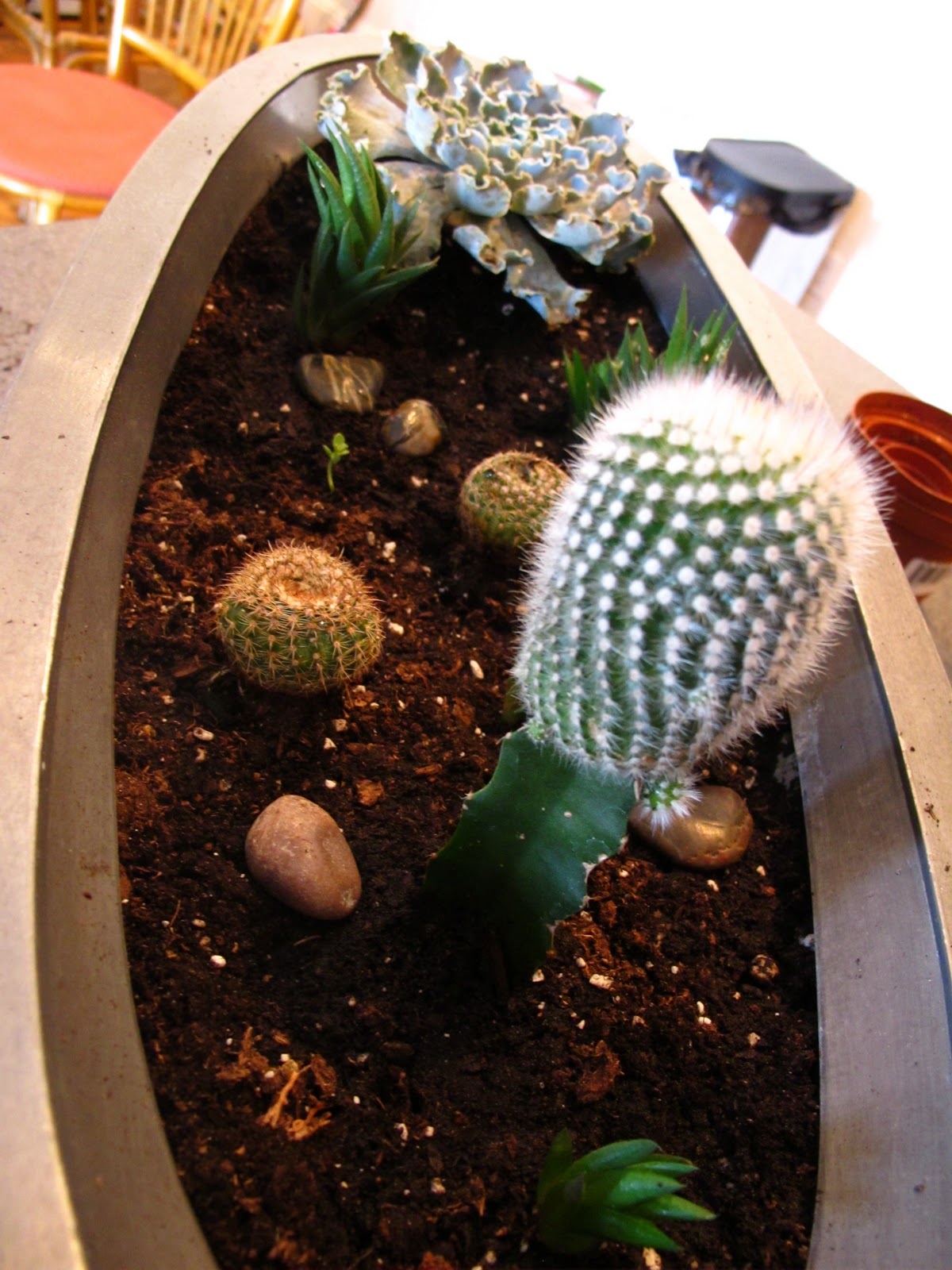
There is a warehouse in Gowanus, Brooklyn where you can buy cast-off props from wrapped movies, television shows, broadway plays, and music videos called Film Biz Prop Shop. My boyfriend ended up scoring a large, canoe-shaped, metal container and wanted to create a succulent garden in it. He enlisted my help and this is what we came up with!
Just like starting a terrarium, because there were no holes in the container we added a layer of rocks for drainage and then a layer of Espoma Organic Cactus Mix.

Next, we laid out the goods to see what arrangement we liked best.
When buying plants sometimes you get more than what you're paying for. One of our succulents ended up being six different little plants.


This little surprise made our succulent scape even better.


When creating a succulent landscape remember to pay attention to the type of soil each plant needs.
Check out Film Biz Prop Shop in Gowanus Brooklyn for interesting gardening containers and home wares.

Thanks for photo help Simon!

Repotting Tomato Seedlings

About a month after I started my tomato seeds the seedlings have outgrown their shared yogurt containers and need to be transplanted to their own separate homes for the rest of their indoor growing life. I had to very carefully separate each little tomato seedling, untangle their tiny roots, and re-pot them to grow big and strong.


I did this about 20 more times until all of my seedlings had enough legroom to continue their journey to be adult plants.

 I admire the resilience of these little tomato plants. A cotyledon trying to shove the seed coat off.
 In about a month these little babies might be ready to grow outside as long as we don't have any more freak Brooklyn hail/snow storms. Fingers crossed!

Thanks boo for photo help!

Plant Propagation

Plants are amazing. Each plant cell has a complete set of that plant's DNA which allows ANY part of the plant to become a new root, stem, or leaf. When a plant is injured it begins to form callus cells to cover the wound. Once the callus cells sufficiently cover the wound they then start to decide what part of the plant they need to become: a root, stem, or leaf. This amazing trait is what plant propagation is all about, making a lot of plants from one plant. Most plants can easily be propagated from stem and root tissue, but some plants can sprout new plants from a single leaf. Succulents are one type of plant that can be propagated this way so I took a single leaf from a Graptoveria plant and laid it on the surface of a container filled with turfis and waited. About a month later this happened!
Hot pink roots and a whole new plant is starting to emerge at the tip of this leaf! 
Amazing.

Hungry Hungry Hello

Seems like my cat Hello also enjoys my terrarium very much!

Tomato Seeds

I started my tomato seeds back in February and now I have 21 healthy tomato seedlings! I'll show you how I started them and where they are now. First, it's important to use a germination mix instead of normal potting soil when starting seeds because you want a medium that is easy for young roots to push through. I used Johnny's Organic 512 Mix which contains 1/2" screened blend of sphagnum (brown) and sedge (black) peat mosses, compost, and perlite. The sphagnum moss holds moisture for the young plant, the compost adds nutrients, and the perlite aerates the soil so that young roots can move through it. The first step in starting seed germination is to make sure that you wet your germination mix well.
The way to tell if your germination mix is sufficiently wet, hold a clump in your hand and if it stays put then you've got enough moisture in it to start the seeds.
For two weeks I saved yogurt containers to use as pots because they are free and the perfect size for small tomato seedlings. You can recycle any plastic container as long as it is food safe because you wouldn't want any toxins in your tomato plants since you are going to eventually eat them. Be sure to thoroughly sterilize your containers before you put seeds in them too. If there aren't holes in the bottom of your container make sure you poke enough for water to easily drain out.

Next fill your container with the moist germination mix and tap it on a flat surface to release any air bubbles that may be trapped in the container.

Now you are ready for the seeds! You should make a hole in the germination mix that is three times the size of the seed and then lightly cover it. I put two in each container for the time being and then when they get too big to share the container I'll split them up. 
Seeds wait for the most optimal situation to finally germinate because they only have one shot. You can facilitate their germination by giving them an even, warm temperature which signals to the seeds that it is spring and time to start growing. Until little green shoots appear, the seeds do not need sunlight so don't worry about putting them near a window until then. I put my seeds in a plastic lasagna dish which created a small greenhouse and kept them above the refrigerator which created ample heat to mimic the warm spring soil. 
And then 12 days later look what happened!
These are the cotyledons, not the true plant leaves. The seed shot them up above ground to start absorbing sunlight to produce energy. At this point the seedling needs as much sunlight as it can get, at least 16 hours, which is a scary amount of light when you have a north facing Brooklyn apartment and it's the beginning of March. So to combat my apartment's lack of direct sunlight I decided to bring my seedlings to work where I have a west facing window on the 8th floor which gets a ton of light. My seedlings seemed to like these conditions better! Here they are at 19 days with true leaves starting to form.

 So, technically a tomato seedling grows in Manhattan, but I promise come spring the plants will be outside in the lovely Brooklyn air.


Thanks to my lovely boyfriend for photo help!